Remote vs Onsite Outsourced IT Support: Which Delivers Better Business Value?
For business leaders assessing outsourced IT support services, the remote versus onsite question is usually framed too narrowly. It is often treated as a matter of convenience, staffing preference, or personal comfort. That is the wrong lens. The real issue is operational efficiency, response economics, risk coverage, service continuity, and whether the support model aligns with how the business actually functions.
Many organisations still think in binaries. Remote support is seen as cheaper but less personal. Onsite support is seen as more reliable but more expensive. In reality, the best decision depends on the type of incidents a business experiences, the maturity of its systems, the number of users, the criticality of uptime, the complexity of its infrastructure, and the level of strategic IT oversight required.
A company that handles most of its work through cloud applications, centralised device management, and well-documented systems can resolve the overwhelming majority of issues remotely with speed and consistency. A business with ageing hardware, multiple physical locations, printer dependencies, fragmented networks, and irregular documentation will often need onsite intervention more frequently. The wrong model creates drag. The right model reduces downtime, improves user experience, and protects growth.
This matters because IT support is not a background utility. It directly affects employee productivity, cyber resilience, customer response times, and the ability of leadership to scale without operational friction. Choosing between remote and onsite support is therefore not a tactical procurement decision. It is a business continuity decision.
Why the Remote vs Onsite Debate Still Matters
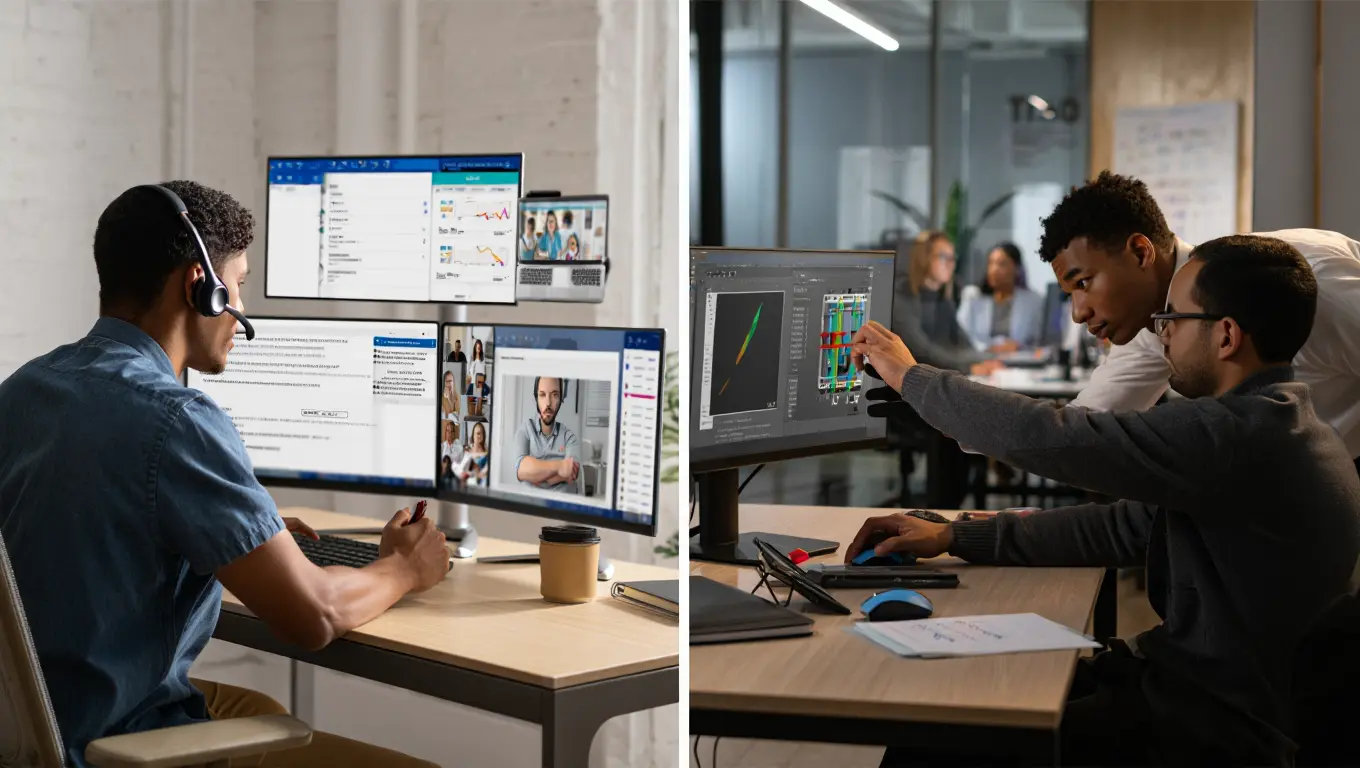
The distinction between remote and onsite support is not just about location. It defines how issues are triaged, how quickly work stops during an incident, what kind of expertise is deployed, and how much the business pays for resolution.
Before the shift to cloud infrastructure, onsite support was the default. If a server crashed, someone had to physically reboot it or replace a drive. If software needed updating, someone walked from desk to desk with installation media.
Modern environments operate differently. Most infrastructure is abstracted to the cloud. Device management can be handled through central policies. Security controls are monitored remotely. As a result, the volume of genuinely hardware-dependent incidents has fallen sharply.
However, the need for physical intervention has not disappeared completely. Office moves happen. Meeting room equipment breaks. Network switches fail. End users damage laptops. The question for decision-makers is not whether to choose exclusively remote or exclusively onsite, but rather how to blend them to achieve the best commercial and operational outcome.
The Argument for Remote Outsourced IT Support
For the majority of knowledge-based businesses, remote support is the primary engine of IT operations. When delivered correctly, it provides significant advantages.
1. Speed of Response
When an employee cannot access an application, waiting for an engineer to travel across a city adds unnecessary downtime. A strong remote helpdesk can often begin troubleshooting within minutes of a ticket being logged. Issues such as password resets, software permissions, application crashes, and cloud access problems are almost always resolved faster remotely.
2. Access to Broader Expertise
An onsite engineer may be an excellent generalist, but they cannot be an expert in everything. Remote support pools resources. If a tier-one engineer encounters a complex firewall configuration issue, they can immediately escalate it to a network security specialist within the same remote team. The business gains access to a broader skill set than any single physical engineer could provide.
3. Commercial Efficiency
Paying for travel time, parking, and physical presence is expensive. Remote support operates with higher utilisation rates, meaning the provider can deliver coverage at a lower unit cost than identical onsite provision. For an SME looking for cost-effective outsource IT support services, remote delivery provides the best mathematical return on investment for standard maintenance and troubleshooting.
4. Proactive Maintenance Capabilities
Effective remote support relies heavily on Remote Monitoring and Management (RMM) tools. These allow the provider to monitor device health, deploy security patches silently, identify impending drive failures, and manage updates across hundreds of devices simultaneously, without interrupting end users.
The Argument for Onsite Outsourced IT Support
Despite the dominance of remote resolution, physical presence retains specific, high-value applications that remote tools cannot replace.
1. Hardware and Physical Infrastructure
If a firewall appliance fails, a core switch burns out, an internet leased line physically drops, or an employee spills coffee on a laptop, remote tools are useless. Physical infrastructure requires physical interaction. Businesses with substantial on-premise hardware, legacy manufacturing equipment, or complex local networks will always require a reliable onsite response path.
2. VIP Support and Cultural Expectations
Some organisations prefer onsite support for cultural reasons. Executive teams often expect "white glove" service where an engineer personally resolves issues. In highly relationship-driven environments, the visibility of an IT professional walking the floor creates confidence that a remote ticketing system struggles to replicate.
3. Environment Complexity and Discovery
When a managed service provider takes over a new, messy IT environment, it is very difficult to document the network, trace cables, identify undocumented hardware, and assess physical security purely from a remote dashboard. Onsite presence is critical for discovery, auditing, and complex troubleshooting where the variables are not fully known in advance.
4. Office Moves, Installs, and Changes (MAC)
Setting up fifty new desks, deploying meeting room AV equipment, racking servers, and physically patching network ports cannot be done remotely. Project execution in the physical world requires onsite engineering.
Evaluating the True Cost Differences
When comparing models, businesses easily fall into the trap of only comparing the monthly retainer fee. A purely remote contract will always look cheaper on paper.
The true cost includes the cost of unplanned disruption. If a business buys a cheap remote-only contract with no provision for emergency onsite dispatch, a critical hardware failure will result in either punishing hourly ad hoc rates or extended downtime while they try to find emergency local cover.
Conversely, paying a premium for scheduled weekly onsite visits when the environment does not technically require them is a waste of capital. A technician sitting at a desk waiting for users to walk up with problems is an expensive and inefficient way to run support.
The most financially efficient model for a modern SME is a strong remote-first contract with guaranteed SLAs for onsite dispatch when hardware or physical intervention demands it.
How Business Size and Structure Dictate the Model
The ideal balance shifts depending on the operational shape of the company.
The Cloud-Native Start-up (10-30 staff)
A business born in the cloud, using SaaS applications, laptops, and no on-premise servers, rarely needs scheduled onsite support. Remote monitoring, remote helpdesk, and zero-touch device provisioning (shipping configured laptops directly to remote staff) provide the highest value. Onsite visits are only needed for occasional hardware breakages or office relocations.
The Established Professional Services Firm (30-100 staff)
An office-based architecture, legal, or finance firm has more complexity. They likely have meeting room technology, secure printing requirements, legacy industry software, and higher security compliance needs. A hybrid model works best here: remote support for 90% of issues, combined with perhaps one scheduled half-day onsite visit a month for physical checks, VIP support, and relationship management.
The Multi-Site or Logistics Operation
Businesses with warehouses, manufacturing floors, multiple retail sites, or heavy physical infrastructure have a much higher reliance on physical connectivity. Handheld scanners, local label printers, and factory floor PCs break frequently. These environments need a provider capable of rapid physical dispatch to multiple locations, not just a strong remote helpdesk.
Key Questions to Ask Providers When Assessing Models
When negotiating an outsourced IT contract, clarify exactly how the geographical and delivery boundaries work.
1. What specifically triggers an onsite visit?
Understand the transition point. If a network goes down, how long will they try to fix it remotely before dispatching an engineer? Time lost in indecision is downtime.
2. Is onsite dispatch included in the SLA, or is it "best effort"?
Guaranteed onsite response times (e.g., a 4-hour physical SLA for critical outages) cost more but provide business continuity. "Best effort" means they will send someone when they have someone free, which is too much risk for critical infrastructure.
3. Is onsite travel and time billed separately?
Some remote "all-you-can-eat" contracts exclude onsite work completely. If an engineer has to visit, assess the hourly rate, call-out fee, and whether travel time is billable.
4. Do you use your own engineers or third-party contractors for onsite visits?
Subcontracting is common, particularly for national coverage, but it introduces variable quality. If the provider uses contractors, ask how they ensure those individuals understand your environment and security protocols.
Conclusion
The choice between remote and onsite outsourced IT support is not an ideological debate. It is an exercise in risk management and operational alignment. Most modern businesses extract the greatest value from a remote-first model that resolves issues quickly and cost-effectively, backed by a clear, contractually guaranteed process for onsite intervention when the physical environment demands it.
Committing entirely to onsite support artificially inflates costs. Committing entirely to remote support leaves the business dangerously exposed to hardware and physical network failures. The best outsourced IT partners do not force a business into a binary choice; they blend both delivery methods to protect uptime, control costs, and keep employees productive regardless of where the fault originates.
If your organisation is reviewing its IT support structure, contact us to discuss which delivery model will provide the most effective protection, response, and scale.
Take the Next Step With Managed IT Security Services
Protect Your Business With Trusted Managed IT Security Services
Cyber threats are a business reality for SMEs, but they do not need to be faced alone. Managed IT Security Services provide structured oversight, professional expertise, and continuous monitoring aligned with how smaller organisations operate.
If your organisation is reviewing its cybersecurity approach or seeking greater confidence in its defences, working with experienced Managed IT Security Services specialists can support informed decisions. Take action by reaching out through a professional contact form to discuss how managed security can support your business goals.
Contact Us Today