Outsourced IT Support Services vs In-House IT Teams: Which Model Actually Delivers Performance
The decision between outsourced IT support services and maintaining an in-house IT team is often framed as a binary choice. In reality, it is a structural decision that affects how a business operates, scales, manages risk, and allocates capital. The wrong model does not usually cause immediate failure. It creates drag. It slows decision-making, increases hidden costs, introduces inefficiencies, and limits the organisation’s ability to respond to change.
Most businesses approach this decision incorrectly. They compare salaries to retainers, headcount to service packages, or perceived control to perceived risk. These comparisons are shallow. They ignore the operational, financial, and strategic implications that determine whether a business can sustain growth without being constrained by its own infrastructure.
A proper comparison must look at how each model performs across critical dimensions: capability, scalability, cost structure, risk management, operational efficiency, and strategic alignment. Only then does the difference become clear.
Capability Depth: Generalists vs Distributed Expertise
In-house IT teams are typically built around generalists. Even when businesses hire experienced professionals, the expectation is that they will cover a broad range of responsibilities. This includes user support, infrastructure management, vendor coordination, security oversight, system upgrades, and troubleshooting.
The limitation is not competence. It is coverage. No individual or small team can maintain deep expertise across all relevant domains simultaneously. As a result, certain areas receive less attention or are handled at a lower level of sophistication. This often includes cybersecurity, cloud optimisation, integration architecture, and long-term system planning.
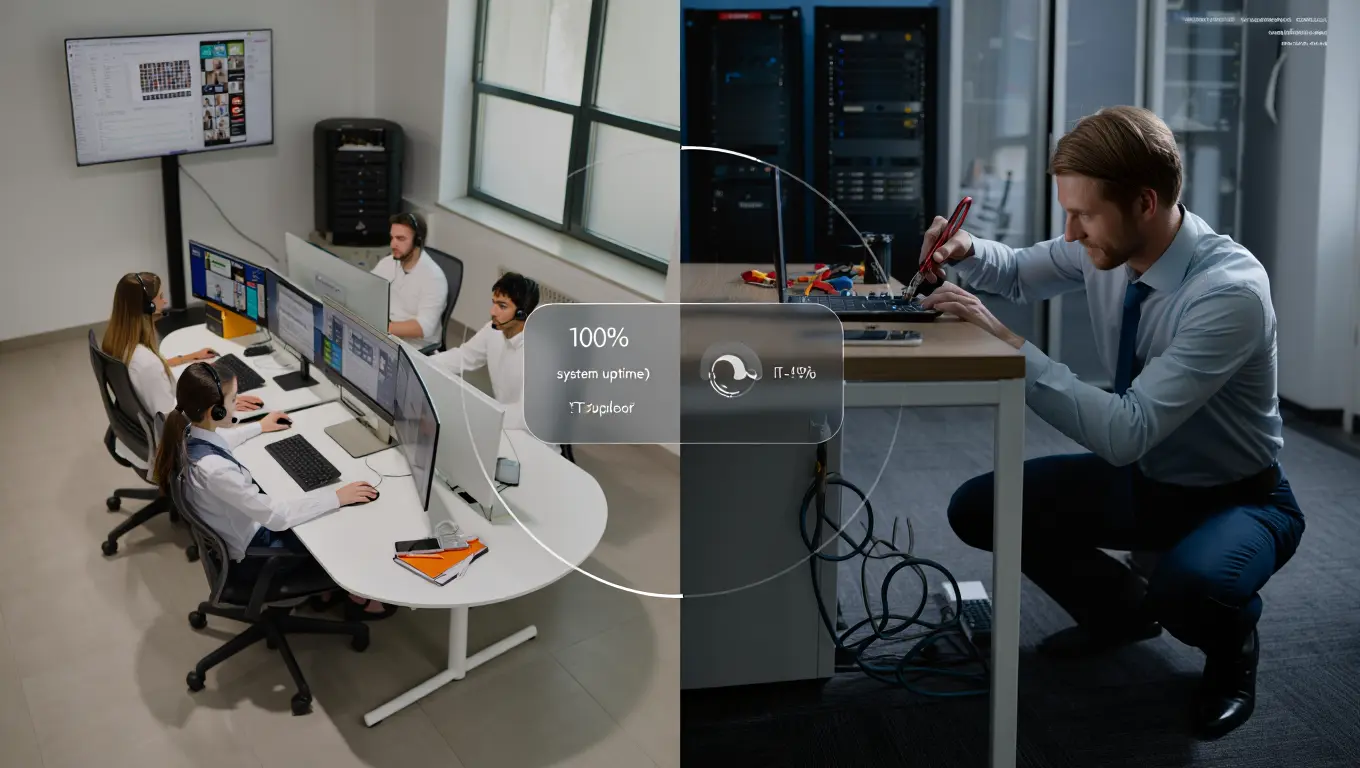
Outsourced IT support services operate on a distributed expertise model. Instead of relying on one or two individuals, businesses gain access to specialists across multiple disciplines. The provider allocates the appropriate expertise to each task, ensuring that complex issues are handled by individuals with relevant experience.
The difference in capability depth has direct operational consequences. Tasks are executed more efficiently, solutions are more robust, and long-term planning is informed by broader industry exposure. For businesses operating in environments where technology plays a critical role, this difference is significant.
Scalability: Fixed Capacity vs Elastic Resource Models
In-house IT teams operate within fixed capacity constraints. The number of employees determines the volume of work that can be handled. When demand increases, the team becomes stretched. Response times slow, prioritisation becomes reactive, and lower-priority tasks are delayed or ignored.
Scaling an internal team requires hiring, onboarding, and training. This process takes time and introduces risk. During this period, the business operates below optimal capacity, often experiencing inefficiencies that impact productivity and performance.
Outsourced IT support services are built for scalability. Providers maintain resource pools that can be adjusted based on demand. When workload increases, additional capacity can be deployed without the delays associated with internal hiring.
This elasticity is particularly valuable during periods of growth or change. Whether a business is expanding operations, implementing new systems, or managing increased user demand, outsourced support can scale accordingly. The organisation is not constrained by its internal structure.
Cost Structure: Fixed Overhead vs Variable Efficiency
The financial comparison between in-house and outsourced IT is often oversimplified. Internal teams are viewed as fixed costs, while outsourced services are seen as variable expenses. While this distinction is accurate, it does not capture the full picture.
In-house IT costs include salaries, benefits, recruitment expenses, training, infrastructure, and management overhead. These costs are largely fixed and do not adjust easily to changes in demand. During periods of low activity, resources may be underutilised. During high demand, additional costs are incurred through overtime, contractors, or delayed projects.
Outsourced IT support services convert these fixed costs into structured, predictable investments. Businesses pay for defined services aligned with their needs. Costs scale more efficiently, increasing only when demand justifies it.
More importantly, outsourcing reduces hidden costs associated with inefficiency. Faster resolution times, reduced downtime, better procurement decisions, and improved system performance all contribute to overall cost reduction. The financial benefit is not just in lower expenditure, but in more efficient spending.
Risk Management: Reactive Response vs Proactive Systems
Risk management is one of the most critical differentiators between the two models. Internal teams often operate reactively, addressing issues as they arise. This is not due to negligence, but to capacity constraints. Preventive measures such as continuous monitoring, regular audits, and system optimisation require time and resources that may not be available.
Outsourced providers operate within structured risk management frameworks. Continuous monitoring systems identify potential issues before they escalate. Regular updates and maintenance reduce vulnerability. Disaster recovery plans ensure business continuity in the event of failure.
This proactive approach reduces both the likelihood and impact of technical issues. For businesses, this translates into greater stability, reduced downtime, and lower financial exposure.
The difference is not theoretical. It is operational. Reactive systems absorb risk. Proactive systems manage it.
Operational Efficiency: Fragmented Execution vs Structured Delivery
Internal IT teams often operate without formalised processes. Workflows are developed organically, based on immediate needs rather than structured design. While this approach can be flexible, it often leads to inconsistency, inefficiency, and a lack of accountability.
Tasks may be handled differently depending on the individual. Documentation may be incomplete or outdated. Performance metrics may not be tracked systematically. Over time, this creates an environment where efficiency is difficult to maintain.
Outsourced IT support services are built on structured delivery models. Standardised processes ensure consistency. Monitoring tools provide visibility into system performance. Service level agreements define expectations and accountability.
This structure improves efficiency by reducing variability and ensuring that tasks are handled in a predictable, optimised manner. For businesses, this translates into faster response times, more reliable performance, and clearer visibility into IT operations.
Strategic Alignment: Maintenance Focus vs Growth Enablement
Internal IT teams are often focused on maintaining existing systems. This is a necessary function, but it limits their ability to contribute to strategic growth. When resources are consumed by day-to-day operations, there is little capacity for innovation or long-term planning.
Outsourced providers bring a broader perspective. Their role extends beyond maintenance to include optimisation and strategic alignment. They assess how technology can support business objectives, recommending improvements that enhance performance and scalability.
This may involve implementing new tools, improving system integration, or automating processes to reduce manual effort. The focus is not just on keeping systems operational, but on ensuring that they contribute to business growth.
Businesses that leverage outsourced IT support services effectively often find that technology becomes a competitive advantage rather than a constraint.
Control and Visibility: Perceived Loss vs Structured Oversight
A common concern with outsourcing is the perceived loss of control. Businesses worry that external providers may not align with their priorities or that communication may be less effective.
In practice, this concern is often overstated. Modern outsourcing models emphasise transparency and accountability. Service level agreements define performance standards. Regular reporting provides visibility into operations. Communication channels are established to ensure alignment.
In contrast, internal teams may operate with less formal oversight. Performance is not always measured systematically, and visibility into system health may be limited.
The key difference is not control, but structure. Outsourcing introduces formal mechanisms for oversight, while internal models often rely on informal processes.
Common Decision-Making Mistakes
Businesses frequently make poor decisions when choosing between these models due to flawed assumptions. The most common mistake is prioritising perceived control over actual performance. Internal teams may provide a sense of familiarity, but this does not guarantee efficiency or effectiveness.
Another mistake is evaluating outsourcing based solely on cost. Lower-cost providers may lack the expertise or infrastructure required to deliver consistent results. This leads to issues that ultimately increase costs.
A third mistake is failing to consider long-term implications. Decisions are made based on current needs rather than future growth. As the business expands, the limitations of the chosen model become more apparent.
Effective decision-making requires a comprehensive evaluation of both immediate and long-term impact.
Hybrid Models and When They Make Sense
It is important to recognise that the decision is not always binary. Many businesses adopt hybrid models, combining internal teams with outsourced support. This approach allows organisations to retain internal knowledge while leveraging external expertise for specialised tasks.
Hybrid models can be effective when structured correctly. Internal teams handle day-to-day operations and user support, while outsourced providers manage complex issues, strategic planning, and system optimisation.
However, hybrid models require clear delineation of responsibilities. Without this, overlap and confusion can reduce efficiency.
Conclusion
The comparison between outsourced IT support services and in-house IT teams is not about preference. It is about performance. Each model has strengths, but their effectiveness depends on how well they align with the needs of the business.
In-house teams offer familiarity and direct control but are limited by capacity and scope. Outsourced services provide scalability, expertise, and structured delivery but require careful selection and management.
For businesses seeking to improve efficiency, reduce risk, and support growth, outsourcing often provides a more flexible and effective solution. The decision should be based on a clear understanding of operational requirements and long-term objectives.
Organisations ready to evaluate their current IT model and explore more efficient alternatives should contact us to discuss how outsourced support can be aligned with their strategic goals.
Take the Next Step With Managed IT Security Services
Protect Your Business With Trusted Managed IT Security Services
Cyber threats are a business reality for SMEs, but they do not need to be faced alone. Managed IT Security Services provide structured oversight, professional expertise, and continuous monitoring aligned with how smaller organisations operate.
If your organisation is reviewing its cybersecurity approach or seeking greater confidence in its defences, working with experienced Managed IT Security Services specialists can support informed decisions. Take action by reaching out through a professional contact form to discuss how managed security can support your business goals.
Contact Us Today